一、摘要
已知稀土离子通过抑制其深能级缺陷而对铜锌锡硫硒(Cu2ZnSn(S,Se)4)器件的性能产生积极影响。在此基础上,首次将铒离子(Er3+)掺杂到吸收体中,对其不利的体缺陷进行了修饰,使其具有优异的电学性能。铒的原子序数相对较大,属于重稀土元素,这种“重”的特性使得铒更倾向于积累薄膜的背面接触而不是表面,从而减少了Cu2ZnSn(S,Se)4/Mo界面的空洞,增强了准欧姆接触。这两个正效应可以帮助Cu2ZnSn4(S,Se)4器件的效率从7.3%(REr=0%)提高到10.9%(REr=0.9%)。我们的研究结果揭示了重稀土离子掺杂对改善Cu2ZnSn4(S,Se)4器件性能的令人满意的协同效果。这也为进一步推动Cu2ZnSn4(S,Se)4薄膜太阳电池的发展提供了一条新途径。
二、研究背景
Cu2ZnSn(S,Se)4薄膜太阳电池因其富稀土、制备成本低、环境友好等优点而备受关注。在过去的几年里,取得了巨大的突破。然而,与CdTe和Cu(In,Ga)Se2的薄膜太阳电池相比,Cu2ZnSn(S,Se)4器件的最高效率仍然较低,需要进一步提高。不合理的开路电压(VOC)缺陷被认为是器件性能的主要限制因素,这既来自于较差的背界面接触,也来自于太多不需要的体缺陷。这些缺陷很可能成为光生载流子的主要复合中心,对器件的性能有负面影响。为了缓解这些缺陷,研究人员开发了多种阳离子掺杂措施,目前取得了显著进展。
三、研究内容
在未掺银的Cu2ZnSnS4前驱体溶液中加入Er(NO3)3⋅5H2O,将重稀土铒离子引入到Cu2ZnSn(S,Se)4薄膜中。研究重稀土铒离子对Cu2ZnSn(S,Se)4薄膜性能及器件性能的影响。
四、图文解析
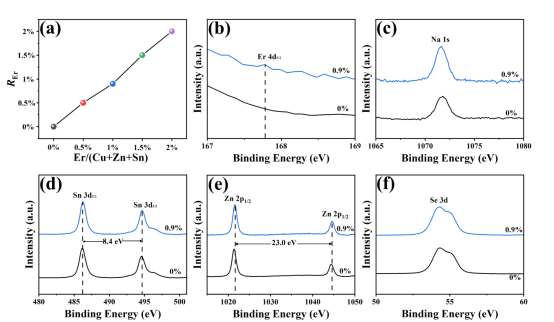
Figure 1.(a) Therelationship between Er content in films and that in the precursor solution. XPS spectra of samples withREr = 0% andREr = 0.9%. (b) Er. (c) Na. (d) Sn. (e) Zn. (f) Se.
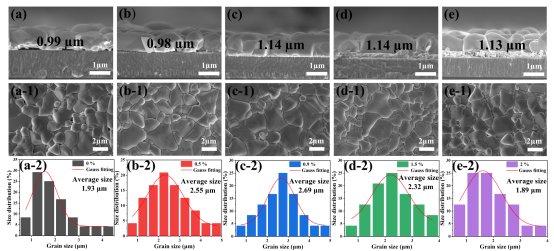
Figure 2.The SEM images and grain size distribution bar chartofthe different Er-doped CZTSSe films. (a) - (e)Cross-sectional images, (a-1) - (e-1) top-view images, and (a-2) - (e-2) grain size distributions.
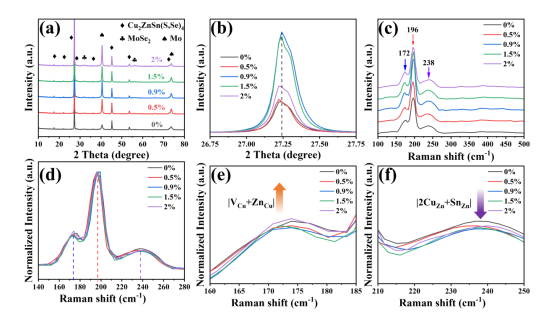
Figure3. (a)XRD patterns, (b)the enlarged (112) diffraction peaks, (c) Raman spectra, (d) the normalized Raman spectra, the amplificationregions at 172 cm-1 (e)and 234 cm-1 (f)ofthe different Er-doped CZTSSe films.
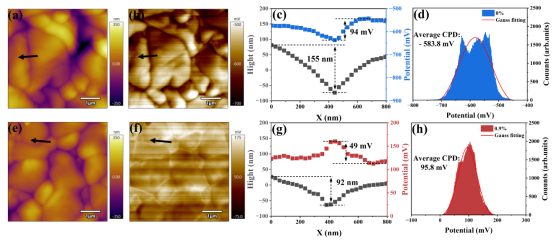
Figure 4.Surface topography, potential maps,GI and GB potential (the region indicated by the black arrow), andmean CPDvalueoffilms without and with Er-doping.(a-d)without.(e-h)with 0.9%of Er-doping.
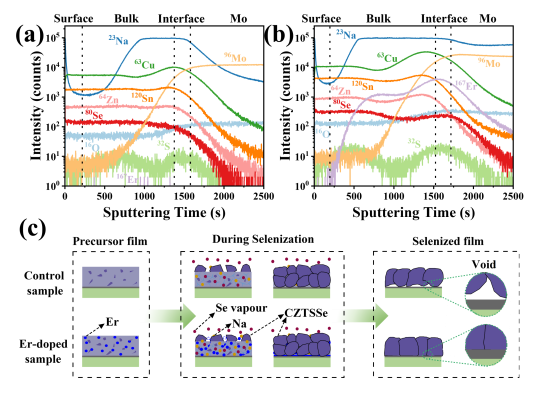
Figure 5.The element depth profiles offilms without and with Er-doping,(a)REr = 0% and (b)REr = 0.9%. (c) Schematic diagrams of the grain growth process without and with Er-doping.
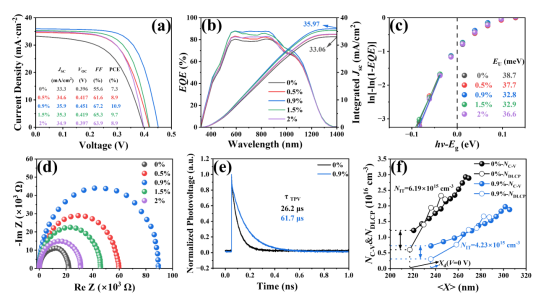
Figure 6.(a) OptimalJ-V curves, (b)EQE spectra and integratedJsc, (c) calculatedEU, and (d)EIS Nyquist plots of the different Er-doped CZTSSe devices. (e) τTPV and (f) C-V/DLCP of samples withREr = 0% andREr = 0.9%.
文章链接:https://doi.org/10.1016/j.cej.2025.162890